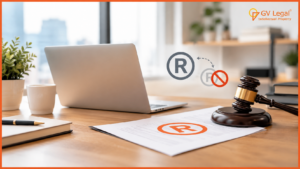
Yes. A logo can be protected by copyright and trademark at the same time, and the two protections do different jobs. Copyright protects the logo as a piece of original artwork. Trademark protects the logo as the signal customers rely on to know who they are buying from.
The catch is that not every logo qualifies for both. A simple wordmark in a standard font may be a strong trademark and have no copyright at all. Knowing which protections your logo can actually claim, and who owns them, is what separates a brand that is secure from one that only looks secure.
Direct Answer: Yes, and Most Well-Protected Logos Have Both
Copyright and trademark are two separate legal systems. Copyright is administered by the U.S. Copyright Office and trademark by the U.S. Patent and Trademark Office (USPTO). Registering one does not register the other, and neither replaces the other.
A logo with original artistic content, such as an illustration, a custom-drawn emblem, or distinctive hand-lettering, can qualify for both. A logo made only of text in an ordinary typeface will usually qualify for trademark protection alone. Most brands that have fully protected their identity hold both where both are available.
What Copyright Protects in a Logo: The Original Artistic Design
Copyright protects the creative expression in your logo: the drawing, the composition, the way the elements are arranged and rendered. It arises automatically the moment the design is created, with no filing required.
Copyright does have limits when it comes to logos:
- Basic geometric shapes, simple lettering, standard typefaces, and familiar symbols generally do not qualify on their own.
- Names, words, and short phrases are not protected by copyright, even when they make up your entire logo.
- The design must reflect a minimum level of creative authorship, which many simple logos do not reach.
Who owns it is a separate question, and it trips up many businesses. If an employee designed your logo as part of their job, the company owns the copyright. If a freelancer or outside agency designed it, the designer owns the copyright by default, in most cases, unless your agreement transfers it in writing. A handshake or a paid invoice does not do that. Plenty of companies find this out when they try to sell the business or send a takedown notice and discover they only hold permission to use their own logo.
AI-generated logos add a newer wrinkle. The Supreme Court declined to review Thaler v. Perlmutter in March 2026, which leaves in place the rule that copyright requires human authorship. A logo produced entirely by an AI tool, with no meaningful human creative input, generally cannot be registered for copyright. A logo where a designer shapes, selects, and arranges the elements may qualify, and the Copyright Office expects applicants to disclose AI-generated material. Trademark rights are unaffected, since they come from use in the marketplace.
What Trademark Protects in a Logo: Its Use as a Source Identifier
Trademark protection does not care how artistic your logo is. It cares whether the logo identifies the source of your goods or services. A plain text logo can be a perfectly strong trademark if it is distinctive, while an elaborate illustration that customers never associate with your business is not.
Trademark rights start with use in commerce and become much stronger with federal registration through the USPTO. Protection is tied to the specific goods or services you offer under the logo, and it can last indefinitely as long as you keep using the mark and file the required maintenance documents.
There are two ways to register a logo-based brand:
- Standard character registration covers the words themselves, in any font, size, or style.
- Special form (design) registration covers the logo’s specific visual appearance.
Many businesses file both, so the name is protected however it is written and the logo is protected as drawn. Enforcement works differently too. Trademark disputes turn on likelihood of confusion rather than copying, which we cover in our guide to what to do about trademark infringement.
| Copyright | Trademark | |
|---|---|---|
| What it protects | Original artwork in the logo | The logo as a brand identifier |
| How it begins | Automatically, on creation | Through use, strengthened by registration |
| Registered with | U.S. Copyright Office | USPTO |
| Needs artistic originality | Yes | No, needs distinctiveness |
| Stops | Copying of the artwork | Confusingly similar branding |
Why One Without the Other Leaves a Gap
Each protection covers a situation the other cannot.
If you only have trademark protection, you may struggle when someone copies your exact artwork onto products in an unrelated field. A trademark claim depends on customers being confused about the source, and a poster or novelty item may not create that confusion. Copyright applies to copying regardless of industry. Trademark protection also does nothing to fix an ownership problem. If your freelance designer still holds the copyright, they, or anyone they license the artwork to, may have rights in the design that complicate your position.
If you only have copyright protection, a competitor can sidestep it by redrawing a similar logo from scratch. No artwork was copied, so a copyright claim may fail, yet customers could easily mistake the new brand for yours. That is exactly the harm trademark law exists to prevent. Copyright also does not protect your business name at all. The same logic applies to your company paperwork, and our guide on why an LLC does not protect your business name explains why entity formation and brand protection are separate steps.
A Practical Filing Order for New Businesses Building a Brand Identity
For most new businesses, the order that works best looks like this:
- Secure ownership in writing first. Before the final invoice is paid, have the designer sign an agreement assigning copyright in the logo, including the final files and the original working files. Everything else depends on you actually owning the artwork.
- Run a clearance search before you commit. Check the USPTO database and common-law sources for similar marks before you print, launch, or pay for signage. Discovering a conflict after launch is far more expensive than before.
- File the trademark application. For most businesses, trademark comes first because it protects your name and logo in the marketplace. If you have not started selling yet, an intent-to-use application can hold your place. Consider filing the words in standard characters and the logo as a design.
- Register the copyright if the logo has real artistic content. Illustrated or custom-drawn logos are the strongest candidates. Registering soon after you first publish the logo keeps the stronger enforcement remedies available.
- Use the right symbols and keep records. Use TM until the trademark registers and ® afterward. Keep signed agreements, dated design drafts, and proof of when you first used the logo.
If your logo was designed years ago and no one ever documented ownership, that is worth fixing now rather than after a dispute, and it is usually a straightforward agreement to put in place. The team at GV Legal helps new and established businesses sort out which protections their logo can claim and in what order to file. You can schedule a consultation with our team to review your logo and set a filing plan.
FAQ
Is a logo protected by copyright, trademark, or both?
Why would I need both types of protection for one logo?
Which should I file first, copyright or trademark?
Related Articles