
Yes, in most cases you still need to trademark your business name even after forming an LLC. Registering an LLC in New York and registering a federal trademark are two separate legal processes that protect two different things, and having one does not automatically give you the other. This is one of the most common misunderstandings new business owners run into, and it can leave a growing brand more exposed than it realises.
If you formed your LLC and assumed the name was locked down, here is what that registration actually covers, what a trademark adds on top of it, and how to tell which one your business needs right now.
An LLC and a Trademark Protect Two Different Things
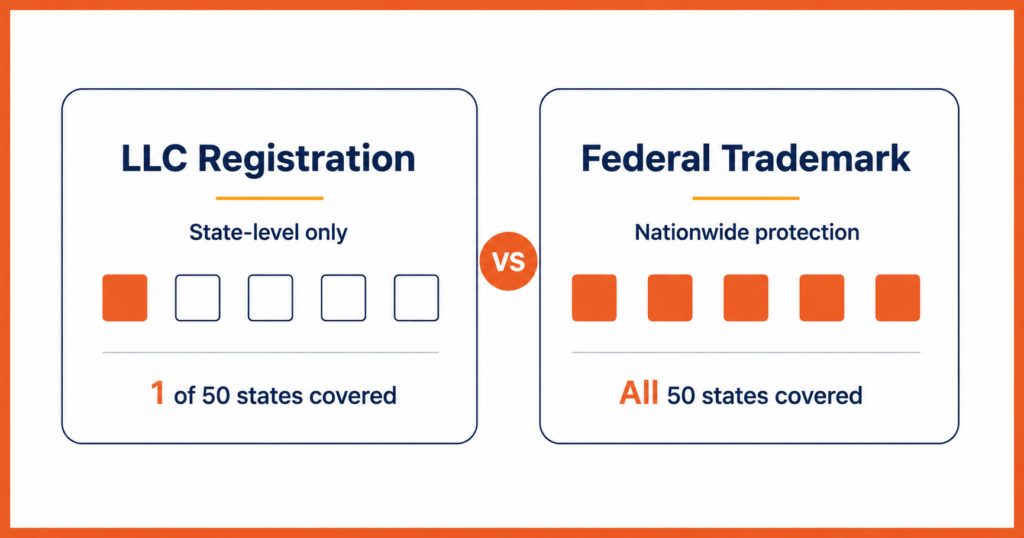
An LLC registration protects your right to operate under a specific name within the state where you filed. A trademark protects your brand name as an identifier of your goods or services, and it can apply nationwide once registered with the United States Patent and Trademark Office (USPTO).
Think of it this way: your LLC filing is an administrative record. It tells New York State that your business exists and that no one else can form an identical LLC name within the state. It does not tell the rest of the country that the name is yours, and it does not stop a competitor in another state, or even a different industry in New York, from using the same or a very similar name for their own business.
A trademark works differently. It is a form of intellectual property that gives you enforceable rights over how your name, logo, or slogan is used in commerce, and those rights can extend across the country and across the specific categories of goods or services you register.
What Forming an LLC in New York Actually Protects
When you file Articles of Organisation with the New York Department of State, the state checks that name against its own database of registered entities. If it is available, you get to use it, and the state agrees not to register another New York LLC or corporation with that exact name.
That is the full extent of the protection. It does not:
- Stop a business in New Jersey, Florida, or any other state from operating under the same name
- Stop a different type of business in New York, such as a retail brand versus a consulting firm, from using a similar name
- Give you any right to stop someone from copying your logo, slogan, or brand identity
- Provide any legal basis to sue for infringement if someone else starts using your name in a way that confuses your customers
Many business owners do not realise this until a naming conflict actually happens. Our earlier piece on why registering a trademark matters in addition to registering your company walks through exactly this gap and why relying on entity formation alone leaves a business exposed.
What a Federal Trademark Protects
A federal trademark, granted through the USPTO, protects your brand name, logo, or slogan as it relates to specific classes of goods or services, and that protection generally applies across the entire United States, not just one state.
Once registered, a trademark gives you:
The exclusive right to use the mark nationwide within your registered categories
Legal standing to challenge or sue businesses that use a confusingly similar name
The ability to use the registered trademark symbol (®), which signals stronger legal protection than an unregistered mark
A public record that can deter other businesses and their attorneys from adopting a similar name in the first place
A foundation for expanding into new states or launching new products without a naming conflict derailing the process
Trademark protection is also tied to how your name is actually used in commerce, not just how it appears on a formation document. If you are still building out your understanding of what qualifies for protection and how the process works, our guide on understanding trademark protection is a good starting point before filing.
A Real Scenario: Same Name, Different States
Here is how this plays out in practice. Imagine two unrelated businesses, both named “Copper Kettle Coffee”, one operating in New York and one in Texas. Both formed their LLCs independently, in their own states, with no knowledge of each other. Both filings went through without issue, because state-level checks only look within that state.
Two years later, the New York business expands online and starts shipping nationally. Customers in Texas start finding both businesses under the same name, and confusion follows. If the Texas business filed a federal trademark application first, even though the New York business may have been using the name locally for longer, the Texas business could hold the stronger legal claim to the name nationwide. The New York business could be forced to rebrand, at real cost to its marketing, packaging, and customer recognition, simply because it never filed for federal protection.
This kind of conflict has become more common as more small businesses build online and multi-state operations. Filing activity and dispute patterns from recent years, covered in our back-at-the-trademark year 2023, show just how often overlapping names surface once a business grows beyond its home state.
How GV Legal,IP Helps Clients Cover Both Bases from Day One
Forming an LLC is often the first legal step a new business takes, but it should not be the last one when it comes to protecting the brand itself. At GV Legal, IP, we work with business owners at exactly this stage, right after entity formation and before a naming conflict has a chance to happen, to make sure the brand is protected as thoroughly as the business entity.
That process typically includes:
A clearance search to confirm the name is actually available for federal registration, not just available at the state level
Identifying the correct goods and services classes so the registration actually covers what the business does
Preparing and filing the federal trademark application with the USPTO
Advising on how to use the name correctly during the application period and after registration
Ongoing monitoring so new conflicting applications are caught early, rather than discovered after a dispute has already started
If you have already formed your LLC and are not sure whether your name is protected beyond New York, it is worth having that reviewed before it becomes a problem rather than after. You can have a consultation with our team to get a clear answer on where your business stands and what, if anything, needs to be filed.
FAQ:
1. Does forming an LLC protect my business name?
2. What is the difference between an LLC and a trademark?
3. Can another business use my LLC name if I have not trademarked it?
Related Articles